

Values Framework for the Organisation of Research


Values Framework for the Organisation of Research
This shared framework is a reference and sets a foundation for appraisal and adaptation: in doing so, contributing to the evolution of research culture. Definitions of the values listed below should be considered flexible to accommodate a diversity of practices and cultures, and according to the specific needs of different domains and settings.
A Values Framework for the Organisation of Research
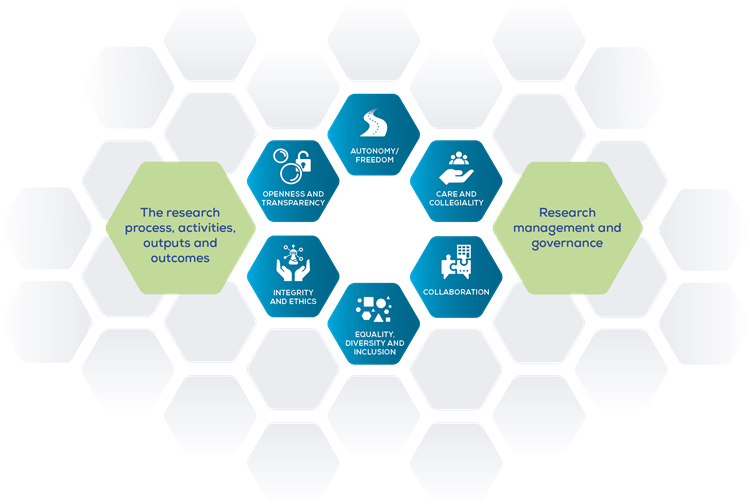
The values are presented in alphabetical order to denote no hierarchy.
 | Autonomy/Freedom Supports the self-governing nature of research and emphasises the importance of the research community and research organisations being free to pursue and express ideas and follow research processes, questions, and activities of their choice responsibly and according to their expertise, interests, and priorities. |
 | Care & Collegiality Reflects the need for research processes, activities, and the research community to care for and nurture the ecosystem that research exists within, including responsible resource use and other social/societal considerations. It highlights the responsibility of the entire research community in creating and maintaining a supportive and respectful environment, free from bullying and harassment, for all involved in the research process, facilitating individual and group growth. |
 | Collaboration Relates to the importance of promoting co-operation (including reproducibility and re-use): 1) between people who have complementary expertise within disciplines (Team Science), 2) across disciplines (inter- and trans-disciplinarity), 3) for the research process in general (replication and reproduction activities), 4) with relevant education, policy, and industry sectors, and 5) with society, where relevant. Collaboration, balanced against competition, is necessary to support quality. |
 | Equality, Diversity & Inclusion Ensures that all roles within the research community are accessible and accommodating to all, regardless of sex and gender, ethnicity, disability, sexuality, class, faith, and other possible factors. It highlights the importance of supporting a diversity of social categories, experiences, competencies, and merits of individuals within the research community as well as the research inputs (methods, data, tools) and outputs (communication and dissemination types) that contribute to the research process and the organisational structures that govern them. These should be accessible to any individual, research unit, discipline, or organisation within the research community and beyond. |
 | Integrity and Ethics Refers to the efforts by all involved to maintain and improve reliability, honesty, respect, and accountability in the research domain through the rigorous conduct and funding of research, as well as in the communication of research processes, outputs, and outcomes. This involves acknowledgement and contextualisation of the current stage of research and of all contributions, standards/methods, continuous quality control, and includes the facilitation and recognition of all aspects of good and responsible research practice. |
 | Openness and Transparency Describes the need for all aspects of research15 to be shared and accessible for examination (whenever possible), re-use, and extension (whilst respecting ethics and integrity) and emphasises the necessity that the research process (from data sharing to evaluation processes) is appropriately explained and justified to relevant stakeholders at all levels. |
Values lie at the centre of the research system and therefore underlie rigorous research processes and activities, outputs and outcomes, research management, and governance.
How will Science Europe work to further embed these values?
Shifting policy and practice to those that better reflect our shared values requires a solid evidence base that can support change, as well as a constant dialogue with all stakeholders.
To move from a conceptual framework to organisational structures and systems where these values are fully embedded, Science Europe will promote collaboration between its members and also towards relevant external initiatives, engaging the voice of the research community in all discussions.
Research on research is needed to evaluate the various ways in which these values are put into practice across countries, disciplines, and types of research organisation. Science Europe will offer a platform to share evidence and exchange upon best practices and lessons learned so that changes can be evolutive.
Science Europe will engage with the research community and consult research organisations, policy makers, and others active in the organisation of research as part of the development of actions to turn these aspirational values into functional practices.