

Research Culture


Research Culture
Member-only content is available on this page. Please log in to view this content.
Research culture is a broad topic that can encompass the behaviours, values, expectations, attitudes, and norms of research systems. We are committed to opening up discussions to create the best possible research ecosystem where researchers thrive.
Why is research culture important?
In the European Research Area (ERA), and globally, there are a diversity of approaches to research cultures that influence the way that research is governed, funded, performed, and communicated. These impact the career pathways of all research professionals, as well as the orientation of research themes and priorities. Importantly, the culture that pervades any given research system influences the quality of its outputs and outcomes.
The topic of research culture offers an opportunity to reflect on the links between the processes and policies that govern research systems on one hand, and the practices and attitudes of those that are involved in the research endeavour on the other. A holistic view is needed when considering policy reforms to areas such as Research Assessment Systems, Open Science, and Equality, Diversity, and Inclusion, that acknowledges the interconnected nature of these key themes.
What are the current aims and objectives of Science Europe?
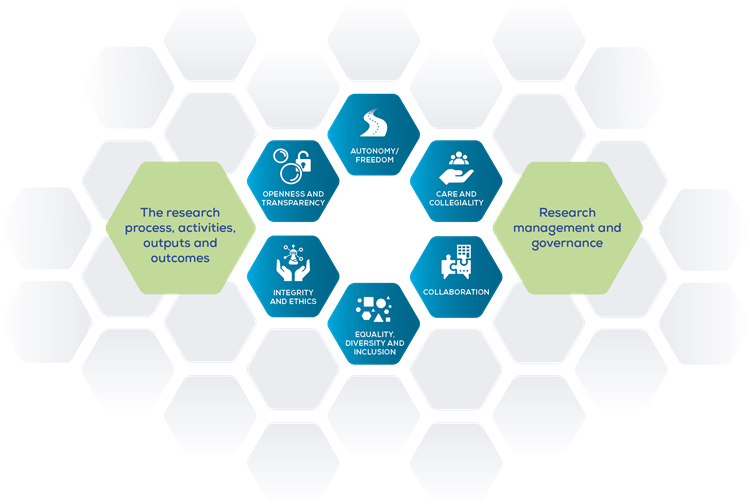
Research culture touches upon the core business of Science Europe’s Member Organisations as it is linked to the quality of research, the contribution of science to knowledge advancement, the role of science in and for society, and the sustainability of research systems as a whole. Science Europe and its Member Organisations use the concept of shared values to design and implement actions to enable positive cultures that foster sustainable research ecosystems where research and researchers thrive.
What is Science Europe doing to achieve these aims?
In 2025, Science Europe presented a Vision and Framework for Research Cultures, synthesising our work to date across numerous policy topics, focussing them on the shared objective of R&I systems to advance knowledge and enable the quality and impact of research.
Continuing our support for the evolution of research cultures in Europe and beyond, Science Europe aims to:
- Inspire the reappraisal of institutional approaches and values to support the quality, diversity, and sustainability of research systems. In doing so, lead and facilitate reflections on the boundaries, degree of self-organisation, and values of the current and future R&I systems.
- Promote coherence between policy areas to improve the research ecosystem and conditions for researchers in it, such as: open science; access to research infrastructures; research integrity; promotion of equality, diversity, and inclusion (EDI); recognition of methodological rigour; transparency; and research assessment reform.
- Bring together, centralise, and maintain a list of existing good practices, policies, and initiatives through a public map and observatory (coming soon) of key actions that contribute to the evolution of research cultures towards our vision.
- Ensure that all activities and actions align with the values that underpin Science Europe’s work.
The Science Europe holistic approach to research cultures, as highlighted in our 2025 Vision and Framework for Research Cultures, will help implement specific actions in the areas above to improve the overall conditions for research activity and for researchers.