

EU Legislation


EU Legislation
Member-only content is available on this page. Please log in to view this content.
The EU frequently implements legislation that (in)directly changes the framework conditions for European research. Science Europe works to defend the rights and opportunities for research and researchers in order to create the best possible conditions for research and innovation (R&I).
Why does EU legislation matter?
The objective of the European Research Area (ERA) is to build a common scientific and technological area for the EU that will help create a more competitive European industry. This area should be based on the free movement of researchers, scientific knowledge, and innovation. The EU frequently implements legislation that (in)directly changes the framework conditions for European research.
Researchers and research organisations need clear rules that help advance research and innovation. EU legislation therefore needs to respond to their evolving needs and practices. To realise ERA, this legislation must promote excellence, openness, and collaboration. When legislation does not aim to regulate research, but does affect it – such as when regulating data and digitalisation, it must build on cross-sectoral synergies to provide the best conditions for high-quality science.
What are the current priorities?
The European Research Area focuses on:
- promoting researcher mobility and knowledge flows
- incentivising investments in research and innovation
- improving gender equality and diversity in science
- fostering co-operation between different research stakeholders.
Further crucial priorities in the coming years will be to:
- address the consequences of the COVID-19 pandemic
- address other societal challenges, such as climate change
- build a more resilient society
To achieve a well-functioning ERA, coherent policies need to be developed at regional, national, and EU level. European authorities must work closely together with national and pan-European research stakeholders. They must develop forward-looking rules that fit the challenges that the world faces.
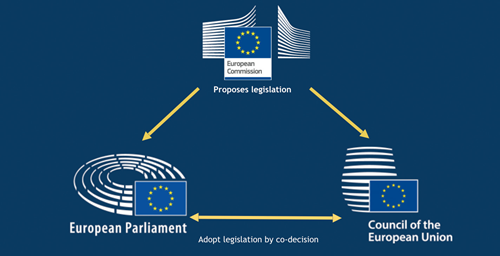
How does the EU legislative process work?
What does Science Europe do to achieve these aims?
Science Europe is a trusted partner of the EU Institutions and regularly shares the expertise and experience of its members with them. It does so in particular in areas related to the Green Deal, digital transformation, societal challenges, and COVID-19. It thereby contributes to the development of a legislative framework that is beneficial to research and helps us to respond to both existing and future challenges.