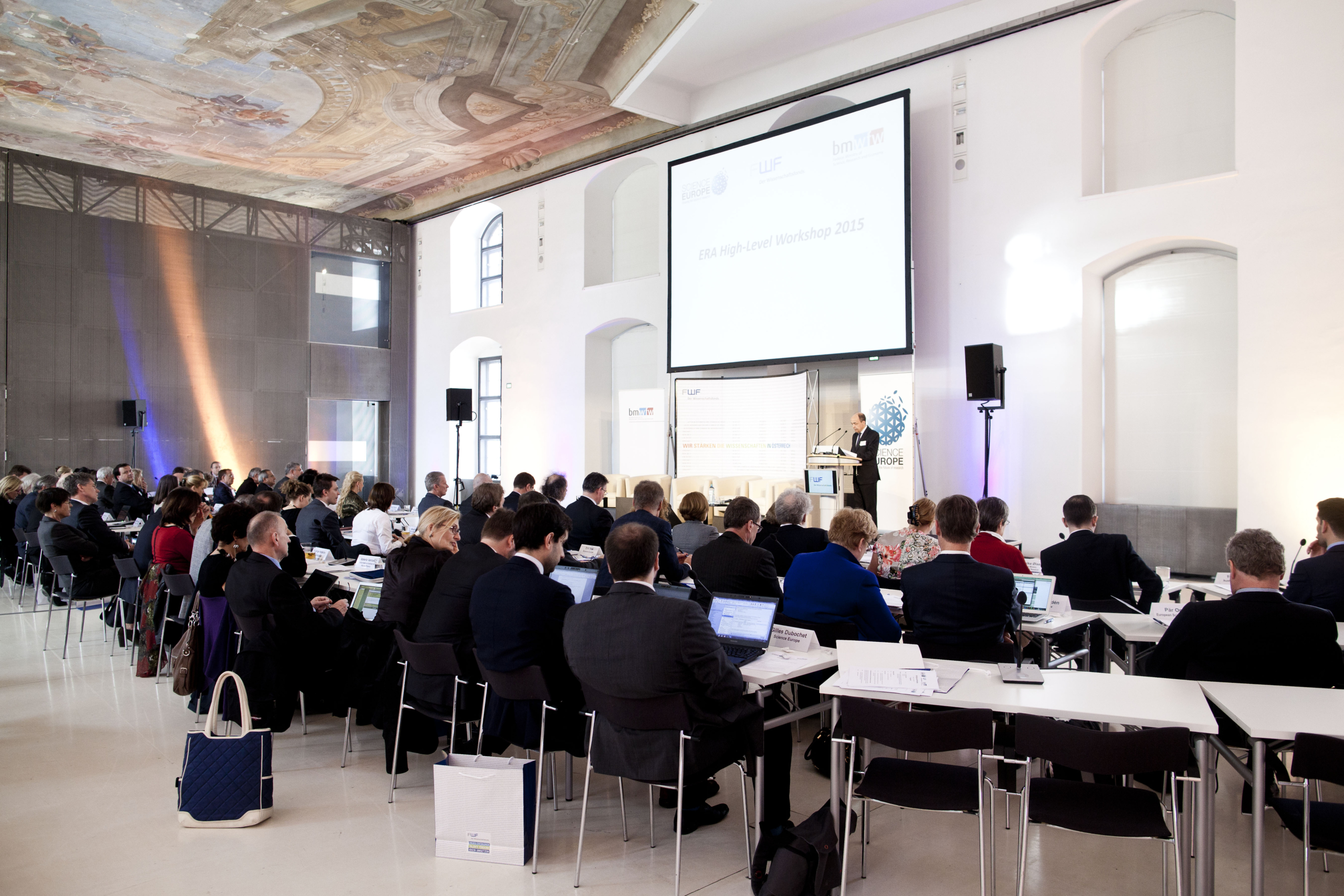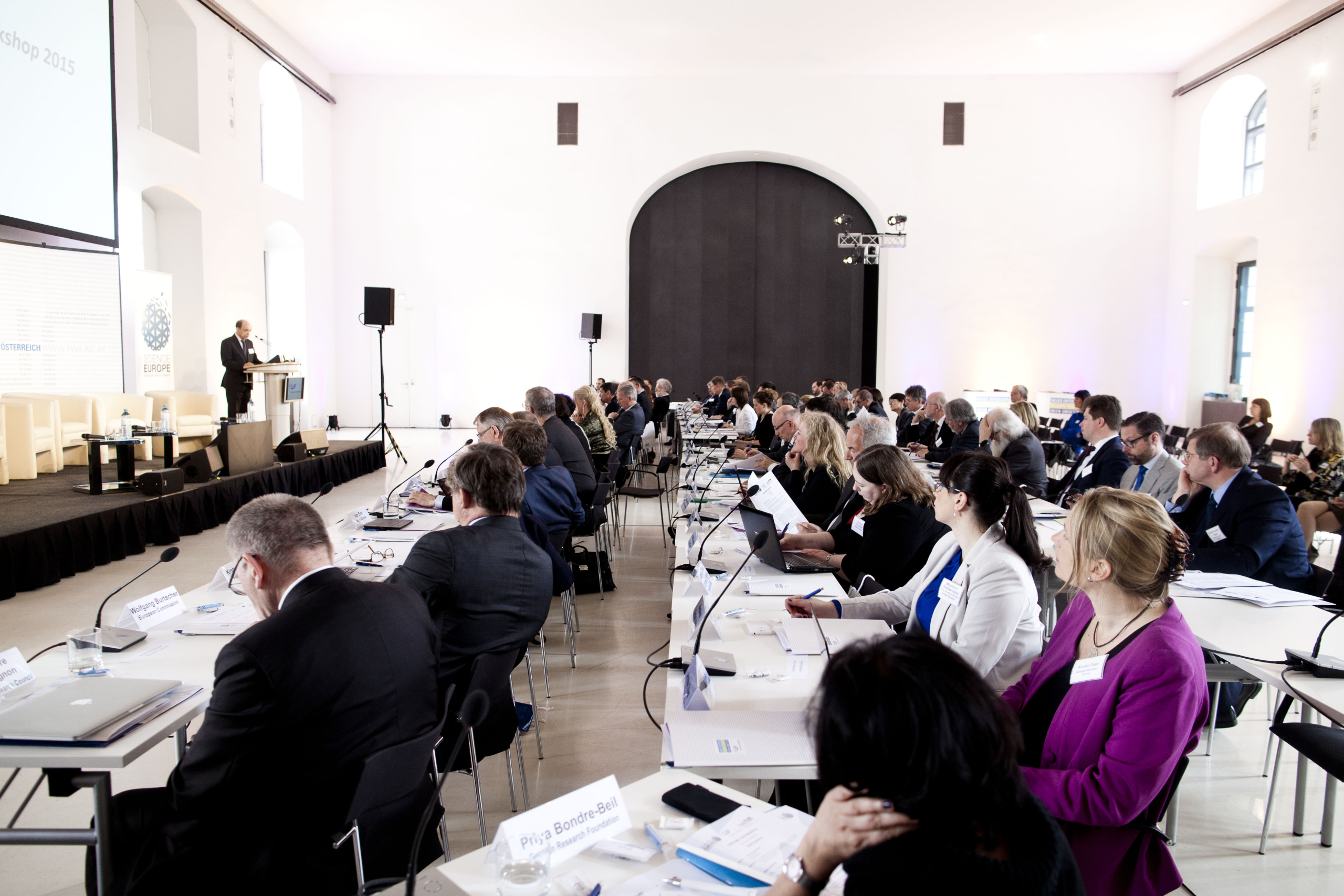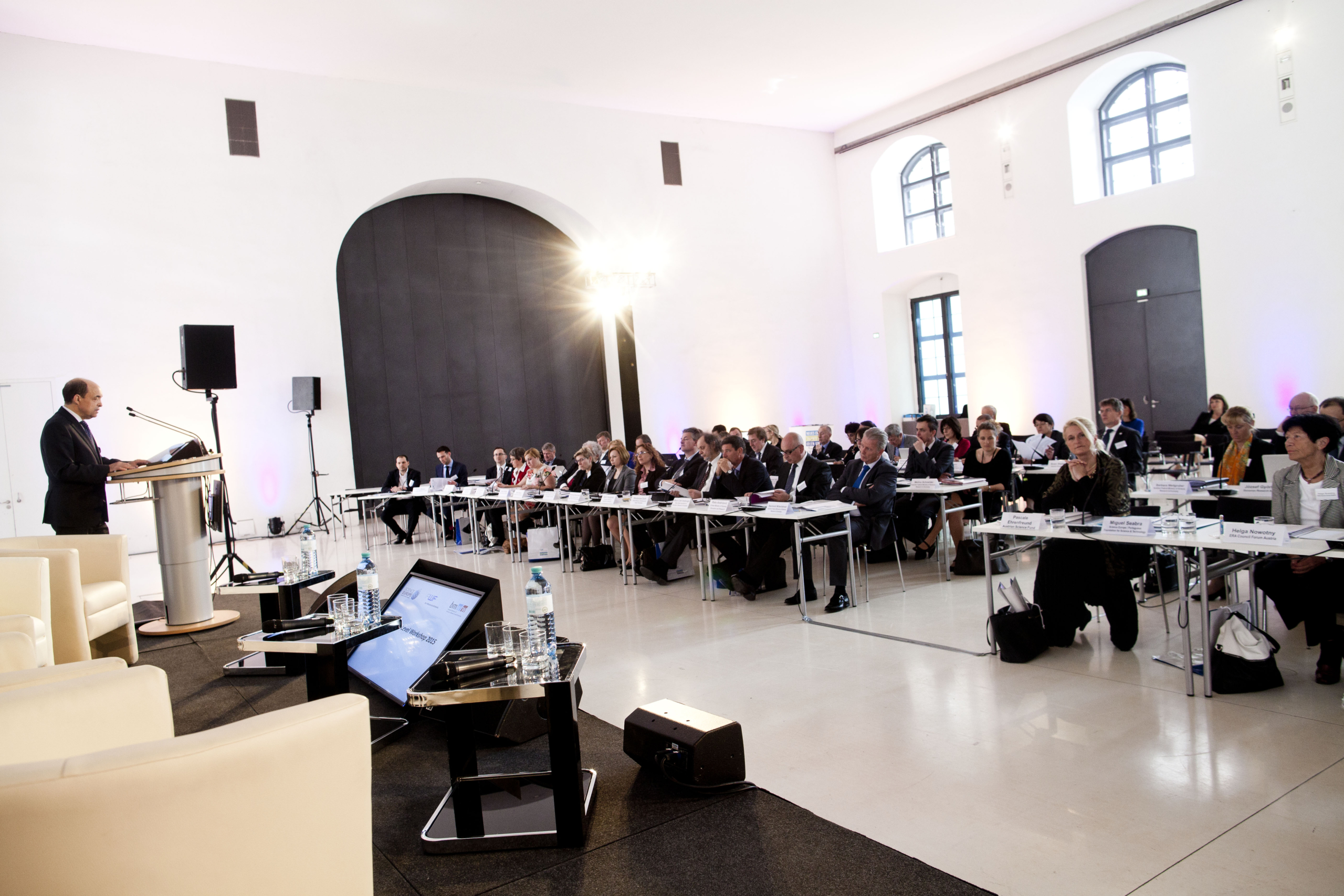
High Level Workshop on ERA 2015


High Level Workshop on ERA 2015
Research-based Innovation and Research Collaboration beyond Europe
The High Level Workshop on ERA offers an annual platform for Science Europe Member Organisations, national ministries, and EU institutions to discuss progress, specific aspects, and future development of the ERA.
The High Level Workshop on ERA 2015 was co-organised in Vienna by Science Europe and:
- Austrian Science Fund (FWF)
- Austrian Federal Ministry of Science, Research, and Economy (BMWFW)
About the event
The 2015 edition of the High Level Workshop focused on Research-based Innovation and Research Collaboration beyond Europe.
For the first time, the HLW was preceded by preparatory workshops – also kindly hosted by FWF in Vienna – during which experts from the SE Working Groups (WGs), Scientific Committees (SCs) as well as external experts had an in-depth exchange of views and experiences on both topics. These gave rise to two input papers which served as the basis for the discussion at the HLW.
Summary
On the first day, discussion focused on the tangible actions that public actors can take to spur the transformation of knowledge into benefits for society. There was broad agreement that there is a specific European problem when it comes to bridging the gap between research results and their absorption outside the research system, for instance by the market in the form of products.
Solving the problem requires a shift in the approach to innovation towards an ‘innovation ecosystem’ that links research and industry, and supports the formation of sustainable ‘innovation communities’ that involve students, senior researchers in academia, their peers in industry, public and private investors and market players to create societal value. Nurturing the ecosystem and the innovation communities through the availability of a strong fundamental science base is the public good that research and innovation policy makers can deliver.
The concepts of public good and an innovation ecosystem were discussed further on day two, when the HLW turned its attention to the topic of Research Collaboration beyond Europe.
Basic research can be considered a universal public good, because its results benefit civilisation and human society as a whole by addressing questions that contribute accumulating knowledge to solving global challenges. Nevertheless, research collaboration is not a spontaneous and self-evident process.
Knowledge ecosystems are both open and closed by nature. Decisions on whether to collaborate or to compete are based on choices made at different levels, from individual scientists, to institutions, to national governments to supra-national structures such as the EU. Decision making in such a complex environment will not always be perfectly strategic.
The rationale for Europe to collaborate, not only internally within the European Research Area (ERA) but also globally, is obvious. Europe’s share of the global scientific output will continue to decrease as other regions increase theirs, not only in terms of quantity but also in terms of quality. With this clear rationale comes pressure to increase alignment and co-ordination of collaboration which, in turn, calls for more strategic approaches if a balance between the national and international mission of research funding and performance is to be maintained. Such a strategy needs to be built on the strengths of Europe, for example the diversity of the research landscape and the myriad co-operation patterns already in place.
Discussion on both days concluded that the ecosystems being discussed do not call for heavy top-down programmes as solutions; rather, they demand several independent but connected strategies, constantly adapted and fined tuned. On the other hand, the ability of bottom-up strategic decision making should not be overestimated either. Therefore an important task identified for Science Europe is one of fostering mutual learning and exchanging practices.
At the basis of both successful innovation and international collaboration strategies lay strong research systems. Scientific capacity has been one of Europe’s strengths historically and, as was mentioned several times during the Workshop, it’s a sound strategy to build on existing strengths.
Photo gallery